


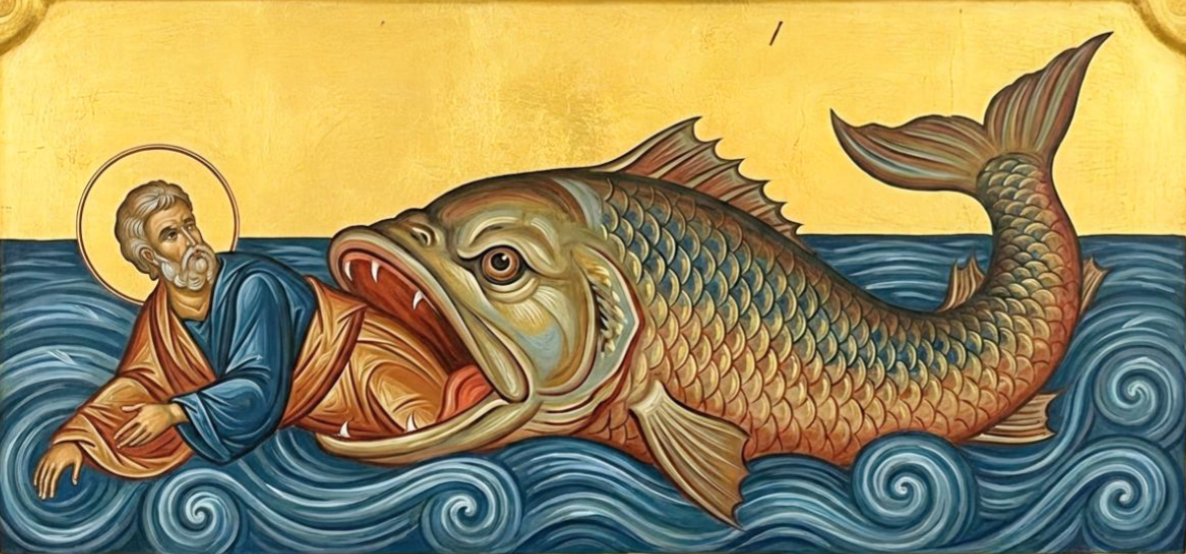
Long ago, in the shadowed days of the Old Testament, when Jonah the prophet strode the earth, the mighty city of Nineveh quaked beneath heaven’s stern decree. “Yet forty days, and Nineveh shall be overthrown!” came the warning, thundering from the prophet’s lips. In humble terror, the king arose from his throne. He issued a royal command: Let every soul, from greatest to least—proclaim a sacred fast! Clothe yourselves in sackcloth and ashes. Cry mightily to God, turning from evil ways and violence. Who knows? He may relent and spare us. The people obeyed, their cries rising like incense. And God, in mercy, saw their repentance. He spared the city, as told in the sacred words of Jonah, chapter 3.

This lent, famously known as the Nineveh Lent, echoes Jonah’s three days in the fish’s belly (Jonah 1:17) and the city’s urgent atonement without food or water.
There is a common misconception that our God, in Old Testament times was wrathful or quick to anger. Yet, this chapter reveals otherwise. It reveals God’s mercy and has profound spiritual significance at the heart of this Holy Biblical passage. This holy Scripture testifies that our God transcends borders, He is not merely the God of Israel but the sovereign Creator of every nation and people.
God’s Reluctant Judgment
God initially commissions Jonah to warn Nineveh of impending doom after “forty days,” not as an act of unbridled anger, but as a call to repentance (Jonah 3:4). This mirrors His pattern elsewhere, think of sparing Sodom if ten righteous were found (Genesis 18). Showing judgment as conditional, always open to mercy.
Overflowing Compassion
When Nineveh repents, from king to livestock donning sackcloth. God relents immediately: “and God relented from the disaster that He had said He would bring upon them, and He did not do it.” (Jonah 3:10, NKJV). Jonah’s own anger highlights human misunderstanding; God responds tenderly, explaining His care for 120,000 souls who “cannot discern between their right hand and their left” (Jonah 4:11). This underscores divine pity over punishment.
Theological Depth
The chapter prefigures Christ: Jonah’s three days in the fish (Jonah 1:17) symbolize resurrection, while Nineveh’s fast inspires the Church’s Lents. It teaches God’s universal love, patience with prophets, and joy in turning from wrath, core to both Testaments, as echoed in Ezekiel 33:11: “I have no pleasure in the death of the wicked; but that the wicked turn from his way and live.”
2 Kings 14:25 (4 Kings 14:25; The orthodox study bible) — here’s the verse, commonly cited in relation to Jonah:
“He restored the borders of Israel from Lebo-hamath as far as the Sea of the Arabah, according to the word of the Lord, the God of Israel, which He spoke by His servant Jonah son of Amittai, the prophet, who was from Gath-hepher.”
Jonah hailed from Gath-hepher in Zebulun’s territory, roughly five miles north of Nazareth, his name meaning “dove”, evokes a mental imagery -Noah’s ark dove that brought tidings.
Jonah’s calling is quite different from that of the other prophets because he is commanded to preach not to his own people, the Jews, but to the Ninevites. The Book of Jonah points to Christ’s great commission (Matthew 28:19-20) in four ways:
1. God’s safeguarding of Jonah fulfills Christ’s promise: “I am with you always, to the end of the age.”
2. “Arise, go to Nineveh” mirrors “Go therefore and make disciples of all nations.”
3. Jonah’s emergence from the whale’s belly prefigures baptism “in the name of the Father and of the Son and of the Holy Spirit.”
4. His preaching to Nineveh echoes the apostles teaching nations “to obey everything I have commanded.”
Nineveh was the capital of the Assyrian Empire. Not only did the Ninevites humble themselves and pray to the God of Abraham, Isaac, and Jacob, but even earlier, the sailors and passengers, having witnessed God’s power displayed in the forces of nature. They were moved to turn their hearts toward the God of Israel.
Later, it was the presence of the Spirit within Jonah that convicted the people of Nineveh, leading them to repentance and the pursuit of salvation. Thus, God draws humanity to Himself through both His presence in creation, which proclaims His power and divinity (Romans 1:20), and through the indwelling of the Holy Spirit in believers, who bear witness to that truth (Acts 2:38–41).
Christ’s Sign of Resurrection.
God summoned Jonah to Nineveh, bearing a dire warning for its wicked hearts. Yet Jonah rebelled, fleeing to Tarshish (modern-day Turkey’s distant shore) boarding a ship in defiant flight from divine will. Patient and sovereign, God unleashed a mighty tempest. The vessel groaned under raging waves; sailors trembled in terror, crying to their gods, while Jonah slumbered deep below. No relief came, the storm surged wilder, threatening to swallow them whole. They roused Jonah, casting lots that pierced the truth: his guilt unveiled. He confessed all and urged, “Cast me into the sea to still this wrath.” The crew rowed fiercely against the fury, but yielding at last, they hurled him overboard. Instantly, the waters hushed; in awe, they glorified Jonah’s God, vowing sacred oaths. A great fish engulfed Jonah, three days and nights in its belly, a living tomb foreshadowing greater mercy to come. There, in darkness, he repented, pouring out psalms of deliverance: “Salvation belongs to the Lord!” (Psalm 3:8); God heard, commanding the fish to vomit him onto dry land, renewed like baptism’s grace; old self drowned, new creation risen, sins washed clean as a caterpillar’s metamorphosis to butterfly. This shadowed Christ’s own death and resurrection: buried in the earth’s dark womb for three days, He conquered sin and death, rising victorious as the firstborn of the new creation. Just as Jonah emerged transformed to preach salvation, Christ triumphed from the grave, offering eternal life to all who repent and believe.
Three days and three nights is a prophetic type of Christ’s three day sojourn in the heart of the earth” (Matthew 16:4, Matthew 12:40)
Matthew 12:40 (NIV): “For as Jonah was three days and three nights in the belly of a huge fish, so the Son of Man will be three days and three nights in the heart of the earth.
Jonah’s Belly of Hades: Womb of Rebirth
In Jonah, the word for “belly” doubles as “womb,” recasting his deliverance, from ship’s hold to whale’s depths, as a vivid type of death’s defeat and baptismal rebirth. As seen in the book of Jonah, the word translated “belly” can also mean “womb.” Jonah’s deliverance, first from the belly of the ship and later from the belly of the great fish—prefigures both deliverance from death and spiritual rebirth through the waters of baptism. His emergence is a kind of new birth. Just as Jonah’s restoration makes possible the repentance and salvation of the Ninevites, so the Resurrection of our Lord from the dead makes possible our own salvation.
In the Old Testament, Hades was understood as the dwelling place of all the dead, a realm of shadowy existence, marked by separation from the presence of God. Especially in poetic passages, it functions as a synonym for death itself. Before the Crucifixion and Resurrection of Christ, Hades held even the righteous dead.
For the Hebrews, the sea was a place of terror: a symbol of chaos, destruction, and death. To be cast into the sea was to descend into Hades, to be overwhelmed by the depths (Psalm 87:7–8).
In a remarkable response to Jonah’s preaching, the people of Nineveh demonstrate the true nature of repentance in several profound ways.
First, they proclaim a fast, an ancient practice that in this context implies a complete and total fast, expressing deep humility before God.
Second, they clothe themselves in sackcloth and ashes. Sackcloth was a coarse, uncomfortable fabric made from goat or camel hair, commonly used for grain sacks. Wearing it was a visible sign of mourning and self-abasement before God (Genesis 37:34; Esther 4:3; 1 Maccabees 2:14; Matthew 11:21). Likewise, placing ashes upon the head symbolized grief, contrition, and repentance (2 Kings 13:19; Isaiah 58:5; Jeremiah 6:26).
Third, they turn to God in prayer, openly seeking His mercy.
Finally, they change their behavior, turning away from violence and evil. This final act reveals the heart of true repentance: it is not merely sorrow or regret, but a transformation that engages both the inner disposition of the heart and the outward conduct of one’s life.
Not only the ordinary laymen but the king himself joined in, from his throne he arose; making this a spontaneous, not a crown decree but a divine awakening. He was inspired by the Holy Spirit.
In chapter 4, we can witness Jonah’s weakness controls over him but he submits to God in prayer, as he expresses his displeasure for God’s mercy towards Ninevites. He knew God’s merciful character and anticipated what would happen; yet, like the proud brother in the story of prodigal son (Luke 15: 11-32), he hoped to see the Ninevites destroyed.
Big Brother Syndrome (often called Older Brother Syndrome) describes the judgmental, self-righteous attitude of the “elder brother” in Jesus’ Prodigal Son parable (Luke 15), resenting mercy shown to repentant sinners while priding oneself on rule-keeping.
In Jonah’s context, it mirrors the prophet’s anger over Nineveh’s spared fate (Jonah 4:1-3), prioritizing personal piety over God’s compassion, much like the elder brother’s refusal to celebrate his brother’s return, highlighting pride’s blinding effect.
The gourd that is damaged by worm is an icon of the soul’s shadowed disposition, wherein pride and envy, those subtle serpents, coil around the heart of the unrepentant beholder, begrudging salvation’s dawn for others. Such dispositions, brooding in humanity’s depths, propel the hands that crucify the Christ, unwittingly weaving their own shroud of ruin. These attitudes, seen in the unrepentant, led many to reject Christ, sealing their own downfall.
The Lord’s rhetorical question to Jonah (Jonah 4:4) serves as a gentle rebuke, its Greek tone implying Jonah has no right to resent divine mercy. Echoing Jesus’ Parable of the Vineyard Workers (Matthew 20:1-16), where the owner generously pays equal wages to all laborers regardless of hours worked, God reveals His compassionate righteousness toward Nineveh.
The people of the nations live in spiritual darkness until the light of the gospel is brought to them by God’s messengers: the apostles, the preachers, and all the faithful, who bear equal responsibility to “make disciples of all nations” (Matthew 28:19). Yet heed Christ’s warning: “Beware of false prophets, who come to you in sheep’s clothing but inwardly are ravenous wolves” (Matthew 7:15). As St. Paul declares, “Even if we or an angel from heaven should preach to you a gospel contrary to the one we preached… let him be accursed” (Galatians 1:8). Teachers face stricter judgment (James 3:1), so guide others with utmost care. Even to “many cattle” God’s mercy flows (Jonah 4:11), embracing all creation in His boundless compassion. The Lord’s compassion extends to all He has created, including the animals.
God’s Omniscient Mercy: From Judgment to Cradle of Faith
Let us close by marveling at God’s boundless love—the Author of time, space, and all creation—who foreknew Nineveh’s brink-of-ruin plight yet stirred true repentance through the Holy Spirit. What was once doomed now cradles Christianity’s ancient heartbeat.
Legacy of Nineveh’s Churches
- Assyrian Church of the East: Historically the largest Assyrian body—not Catholic or Eastern Orthodox—using East Syriac (Aramaic), often tagged as “Nestorian.”
- Chaldean Catholic Church: Assyrians in Rome’s communion, sharing East Syriac heritage with a robust presence on Iraq’s Nineveh Plains—today’s largest Christian denomination among local Assyrians.
- Syriac Orthodox Church: Bearing Oriental Orthodox roots in the region. (I, the writer, am a devoted Syriac Orthodox Christian from the Indian Orthodox Syrian tradition, faithfully embracing our Western rites and wholeheartedly affirming our belief in the intercession of the Holy Theotokos, blessed Mother Mary – mother of God.)
Even nature’s creatures—land beasts, sea depths, flora and fauna—bow to His sovereign will. Always pray for His mercy, embrace repentance, and remember this sinful writer in your intercessions. May the Holy Theotokos, blessed Mother Mary, intercede for us, as at Cana’s wedding feast; transforming our lives into the finest wine of Christ.
“Jonah preached and the city believed; the prophet spoke briefly, but the repentance of Nineveh spoke loudly before God.” ~ St. Ephrem the Syrian (c. 306–373 AD)
~ J George Thomas (aka A R T)
Leave a Reply